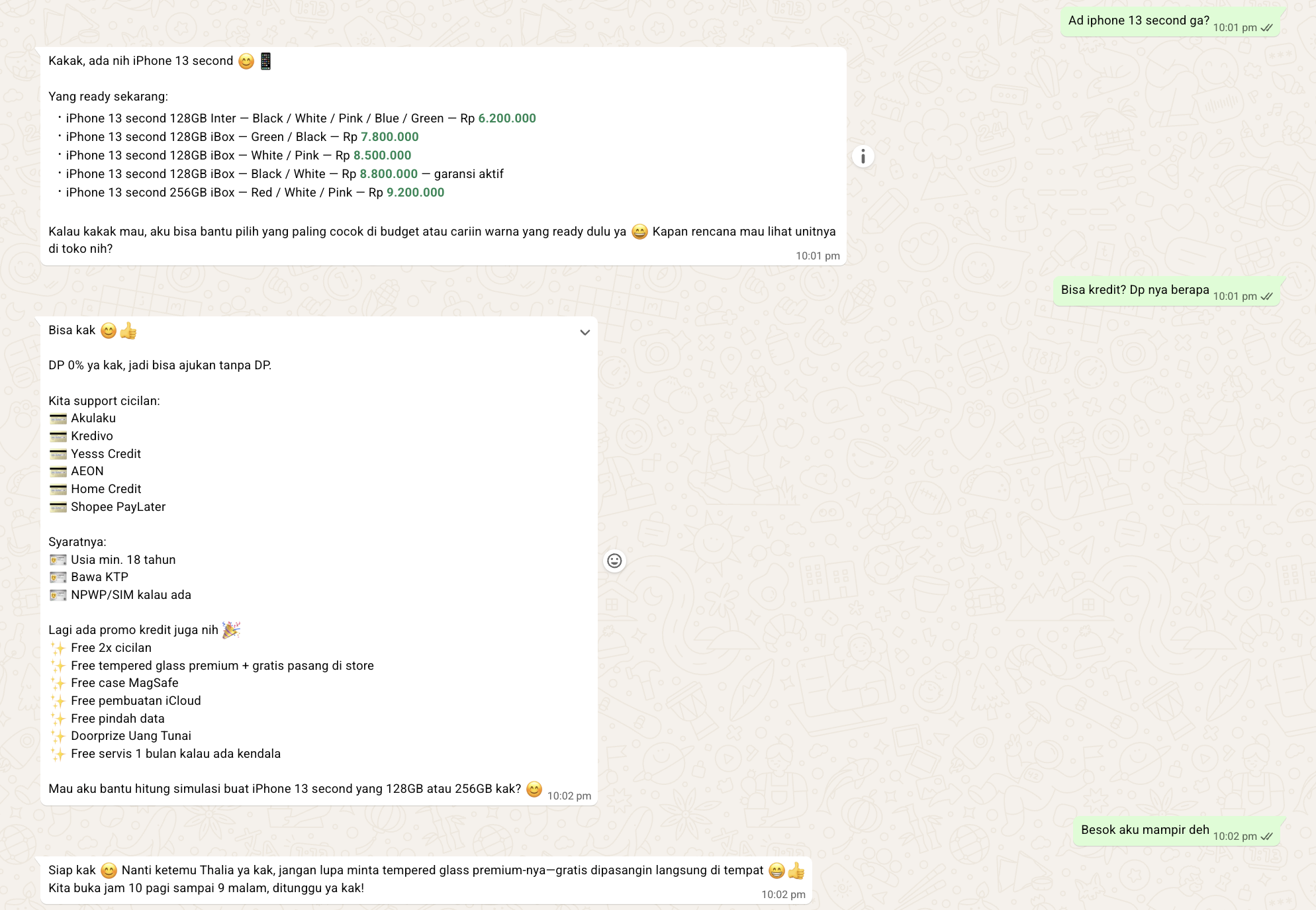
WhatsApp AI customer service for iPhone Victory
Client
iPhone VictoryWebsite
iphonevictory.comCategory
AI IntegrationProject Type
WhatsApp AI CS & sales assist (iPhone retail)Before
The shop was flooded with the same WhatsApp questions all day: stock, price, instalments, warranty, location, trade-in. Staff were serving customers on the floor, chats piled up, and buyers moved on to the shop next door. Around 230 messages arrived per day, and 30% of new leads showed up outside working hours (21:00-09:00).
After
Chats now get answered in under a minute, around the clock, always from real stock data. In the first 80 days the assistant answered roughly 18,000 customer messages - 99% of all outbound replies. The chat closing rate rose from 0.82% to 2.99%, a 3.65× increase. Staff still take over for negotiation, complaints, and closing in store.
Bridge
We wired the WhatsApp agent into the shop's inventory database, wrote down explicitly what it may and may not say (negotiation happens in store only, never quote stock levels, never promise a final instalment figure), added tools for credit simulation, location and trade-in estimates, and set up automatic escalation to staff the moment a buyer turns serious or arrives at the mall.
Challenges
Repetitive chats pile up at peak hours
Stock, price and instalment questions arrive non-stop while staff are serving the customer standing in front of them.
Answers must follow stock data, not staff memory
Prices and availability change daily. A wrong answer only surfaces once the customer has already travelled to the shop.
A third of new leads arrive after hours
30% of new leads land between 21:00 and 09:00, when nobody is there to reply.
Solution Highlights
Every answer read from the inventory database
Availability, price, colour, storage, warranty and battery condition are all checked against the shop's database before anything is sent to the customer.
A sales flow, not just an FAQ
Zero-down credit simulation, trade-in and buyback estimates given as ranges, then an invitation to visit. The moment a customer names a day, the agent closes with an appointment template.
Clear limits and human escalation
Negotiation and payment stay in store. Serious buyers, complaints, and customers who have already arrived are routed to staff automatically.
Client Introduction
iPhone Victory (iphonevictory.com) is an iPhone retailer selling both new and second-hand units, with heavy WhatsApp traffic. Almost every transaction still closes in the shop - chat is the front door, and that door was least attended exactly when the shop was busiest.
Project Journey
We started from how the team answered on day one: which messages were pure stock checks, which genuinely needed a human, and which rules had only ever lived in the owner's head.
Once those rules were written down explicitly, the agent was wired to live stock data and rolled out in stages. Two rounds of owner feedback in the first fortnight changed the answering style considerably. The result was measured on the same WhatsApp line, before and after: from 0.82% of chatters going on to buy (four months answered by staff) to 2.99% (the first two months with the AI). The chat closing rate rose 3.65×.
Core Development
What we shipped:
- A WhatsApp agent that reads stock straight from the shop database before stating any price, colour, storage, warranty or unit condition
- Zero-down 12-month credit simulations delivered as an image, with no instalment maths improvised in chat
- Trade-in and buyback estimates expressed as price ranges, following the shop's own formulas
- Location and opening-hours tools, plus escalation to staff for serious buyers, complaints, and customers already on site
- An operator dashboard so staff can take over any conversation at any time
- The iphonevictory.com website: a per-model catalog with price, storage, colour and warranty, read from the same stock data the AI uses, with every WhatsApp button leading straight to the agent
Proof Note
Measured by matching customer WhatsApp numbers against the shop POS transaction data - not inferred from chat sentiment. The closing rate compares the same WhatsApp line: four months answered by staff (1,219 chatters, 10 buyers, 0.82%) vs the first two months with the AI (1,069 chatters, 32 buyers, 2.99%). The rupiah figures belong to the client; only the ratios are published here.
Proof Snapshot
Measured on the same WhatsApp line, before and after, by matching customer numbers against the shop transaction data: from 0.82% of chatters going on to buy (answered by staff) to 2.99% (with the AI).
iPhone Victory — Measured result, before vs after
Want a similar result in your business?
Book the automation audit and we will map the best workflow to fix first.
Book Audit